Introduction
Real estate has long been one of the most illiquid asset classes, making it challenging for investors to quickly buy or sell property stakes. With advances in blockchain technology, however, real estate tokenization is emerging as a powerful solution, enabling fractional ownership, enhancing accessibility, and ultimately driving improved liquidity in previously stagnant markets. In this blog, we explore how tokenization addresses the liquidity bottlenecks in real estate and the broader implications for the investment landscape.
What Is Real Estate Tokenization?
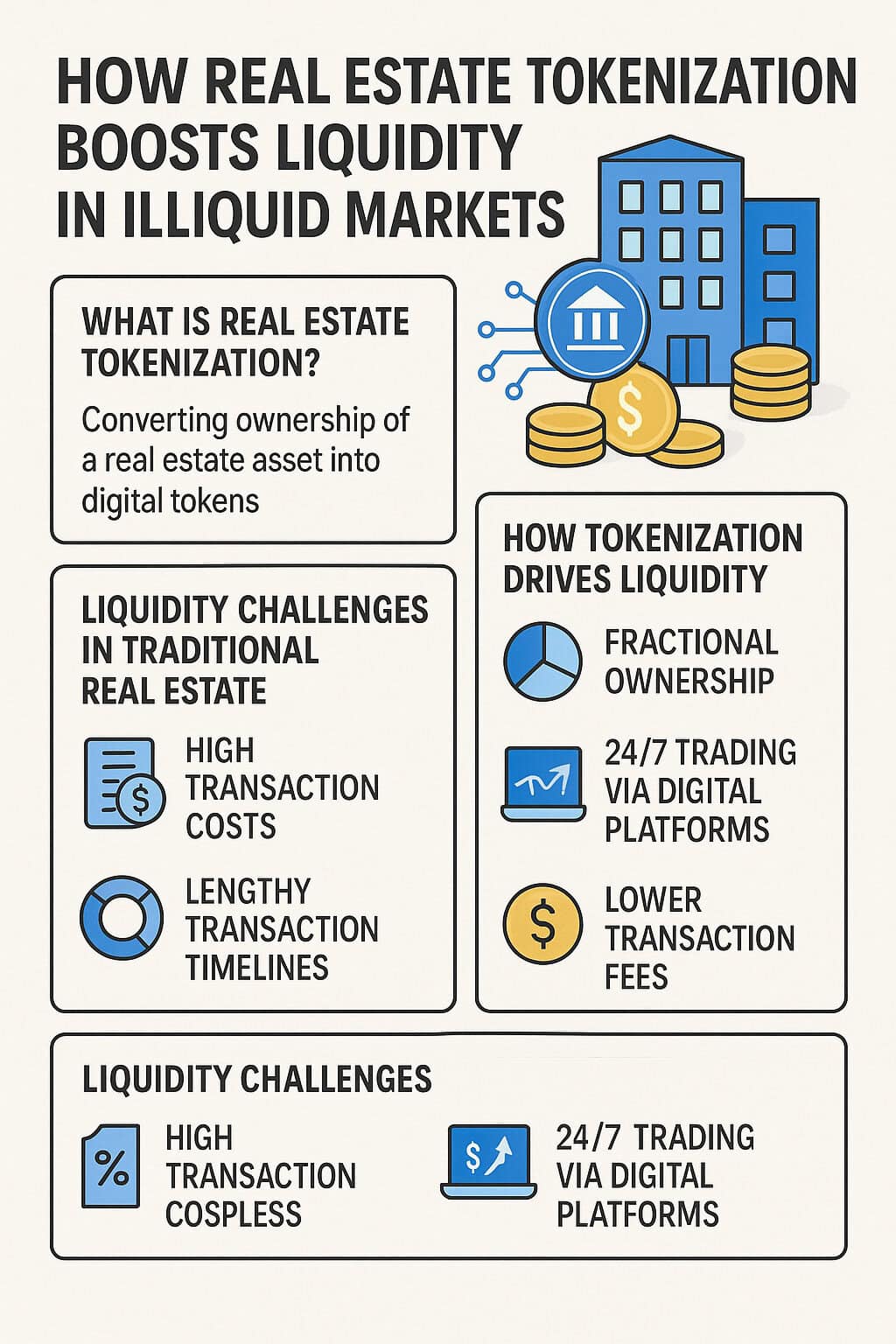
Real estate tokenization refers to converting ownership rights in a real‑estate asset into digital tokens on a blockchain. Each token typically represents a fractional share of the underlying property, enabling investors to gain exposure without purchasing the entire asset.
The Role of Blockchain Technology
Blockchain underpins this process by providing transparency, security and immutability. Smart contracts automate contractual agreements and transfers, reducing intermediaries and streamlining operations.
Why Traditional Real Estate Lacks Liquidity
High Transaction Costs
Property transactions often involve large fees, legal, brokerage commissions, taxes and more, making frequent trading cost‑inefficient.
Lengthy Transaction Timelines
Buying or selling real estate can take weeks or months due to due diligence, regulatory compliance and paperwork, creating a barrier to fast trading.
Limited Market Access
Many investors are excluded from high‑value property markets because of large capital requirements and complexity, which suppresses trading volume and liquidity.
How Tokenization Drives Liquidity
Fractional Ownership = More Participants
By slicing a property into smaller digital tokens, tokenization lowers the entry barrier and opens up investment to more individuals. This increase in participants can help boost market activity and trading volume.
24/7 Trading via Digital Platforms
Tokenised real‑estate shares can be traded on blockchain‑based platforms, often around the clock, unlike traditional property markets that operate in fixed hours and with limited primary/secondary trading.
Lower Transaction Fees & Faster Processes
Many intermediaries can be eliminated in a tokenised model, smart contracts manage transfers, and blockchain ensures transparency—reducing both cost and time.
Key Benefits of Real Estate Tokenization
Democratizing Access to Real Estate Investing
Improved Portfolio Diversification
With smaller investment units, investors can spread risk across multiple properties, locations and asset types, rather than concentrating capital in one large property.
Enhanced Market Transparency
Transactions and token ownership are recorded on the blockchain, providing verifiable, auditable trails of ownership and activity, boosting investor trust and reducing fraud risk.
Challenges & Considerations to Keep in Mind
Regulatory and Legal Frameworks
Technology Adoption & Education
Stakeholders must adopt new technology, understand token‑mechanics and manage smart contracts—which can be a hurdle especially for more traditional real‑estate players.
Market Liquidity Isn’t Guaranteed
Although tokenization creates the potential for liquidity, actual trading volumes remain limited in many cases. Studies show that many tokenised real‑world assets have low secondary market activity.
The Future of Real‑Estate Tokenization
Integration with the Global Financial System
As regulatory clarity improves and infrastructure matures, tokenised real estate is likely to become more seamlessly integrated into global capital markets, enhancing cross‑border investment flows and liquidity.
Advancements in Smart Contracts
Next‑generation smart contracts will support advanced functionalities, automated dividend distributions, dynamic pricing, real‑time compliance and multi‑asset token bundles.
Synergies with AI & Data‑Driven Insights
Conclusion
Real‑estate tokenization is redefining one of the most illiquid asset classes by enabling fractional ownership, 24/7 digital trading, and lower costs, thereby unlocking new liquidity and accessibility. While challenges around regulation, technology and actual market trading persist, the momentum behind tokenisation is strong, and its potential to democratise property investment and fuel liquidity is significant. For investors and property owners alike, embracing this transformation could open unprecedented opportunities worldwide.
FAQs
Q: What types of properties can be tokenized?
A: Residential, commercial, mixed‑use, development projects and even real‑estate debt can be tokenised depending on the platform and legal structure.
Q: Does tokenisation guarantee I can sell my stake instantly?
A: Not always—liquidity depends on the platform, regulatory permissions and secondary market activity. Tokenisation enables potential liquidity, but does not guarantee instantaneous exit.
Q: Are tokenised real‑estate investments safe?
A: They carry risks—regulatory uncertainty, platform risk, underlying property risk and potential low trading liquidity. Proper due diligence remains essential.
Sources:
- EY Insights – Tokenization: From Illiquid to Liquid Real Estate Ownership
- EUR.nl – Real Estate Tokenisation Gains Traction: Study Reveals Insights into Ownership and Liquidity
- Brickken – Real Estate Tokenization and Liquidity
- ChainUp Academy – Real Estate Tokenization Guide
- Lofty.ai – The Ultimate Guide to Real Estate Tokenization 2025
- arXiv – Tokenized Real World Assets: Analysis of the Emerging Market


Comments are closed here.